
NDIS explainer
NDIS community participation in Newcastle, Lake Macquarie and Maitland: what "community access" covers and how to use it
A support worker helping you get out, join in and build a life outside the house. This guide explains what community participation (community access) covers, the core and capacity building versions, what the NDIS does not pay for, and how it works with Your Way Living® in Newcastle, Lake Macquarie and Maitland.
7 min readBy Your Way Living®
The short version
- "Community participation" and "community access" mean the same thing in everyday use: a support worker helping you take part in life outside your home, like shopping, a class, a sports club, a market or an appointment.
- The NDIS has two support categories with similar names. "Assistance with social and community participation" sits in the flexible core supports budget. "Increased social and community participation" sits in the capacity building budget and is a stated support.
- NDIS funding generally pays for the support worker's time, not the activity itself. Tickets, entry fees, memberships and meals are usually your own cost.
- The NDIS says you are in control of who you work with, what you do together and when. A service agreement makes the arrangement clear.
- Your Way Living® supports people out in the community across Newcastle, Lake Macquarie, Maitland and the Hunter, with transport when it is part of the plan. All plan types are welcome.
Most NDIS plans in Newcastle, Lake Macquarie and Maitland have some funding for getting out and about. On the plan it is called "assistance with social and community participation". Most people just say "community access" or "community participation". This guide explains what it covers, where the money comes from, what it does not pay for, and how to put it to use. We checked every NDIS rule here on the NDIS website on 18 November 2026.
What community participation means
Community participation is support to take part in life outside your home. The NDIS says core supports help you "with everyday activities and getting involved in your community", and that the social and community participation category is for people whose goal is to "spend more time in your local community and get involved in group or social activities and events".
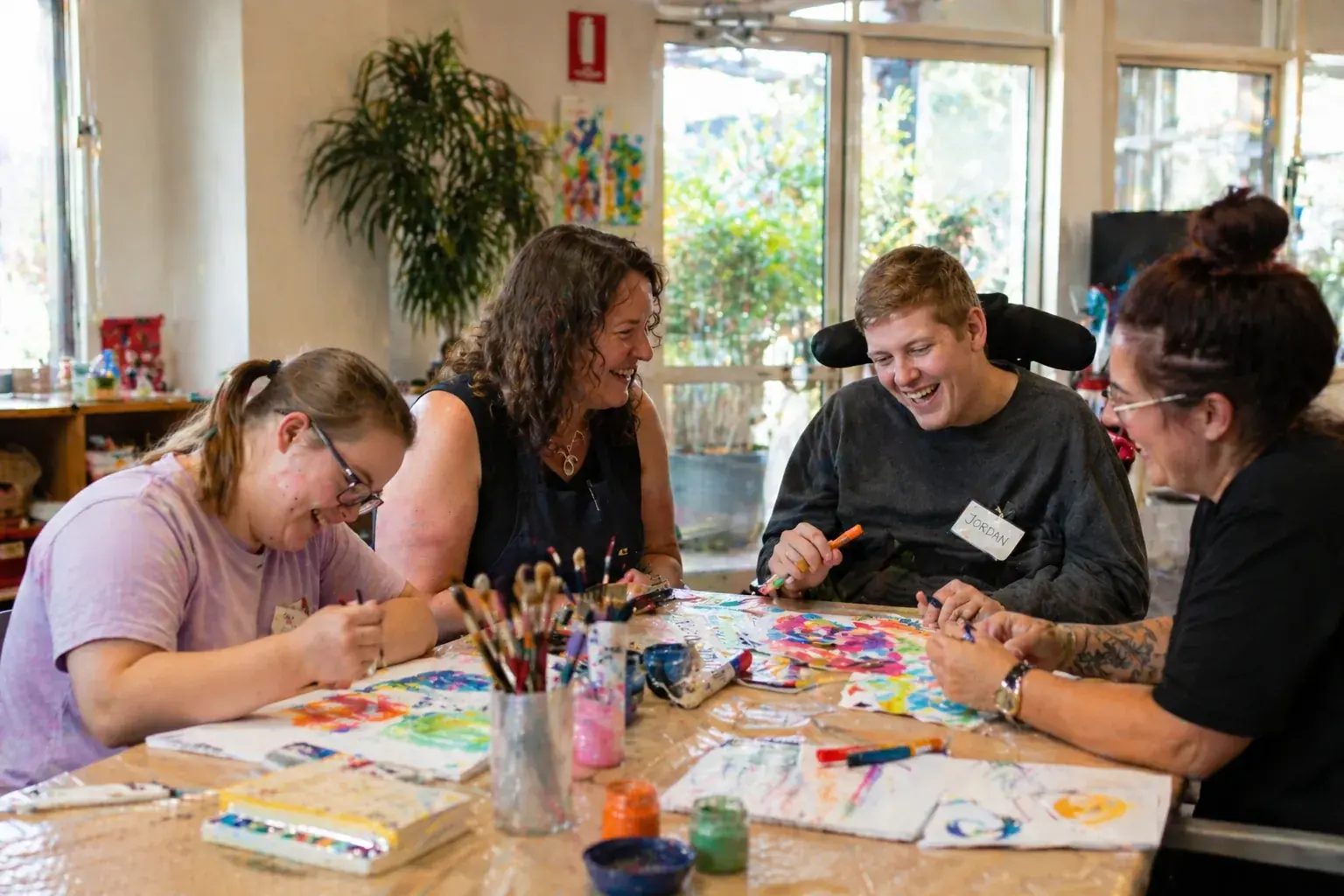
In practice, it is a support worker going with you. The NDIS website lists the kinds of things a support worker can help with in the community: attending social events, joining activities, going to a farmers' market or a social craft group, getting to a medical appointment, and building your confidence to access the community on your own.
- a swim at the local pool, a gym session or a walk along the harbour or the lake
- a weekly art, cooking or music class, or a library reading group
- the shops, the markets, a cafe, a footy game or a concert
- church, a community meeting, a volunteering shift or a club
- getting to and from an appointment, and having someone with you in the waiting room
- learning the bus or train route so you can do the trip yourself one day.
The point is your life, not the outing
Good community support is not a support worker choosing an activity for you. It is you choosing what matters to you, and a worker helping you do it. The NDIS says you are "in control of who you work with and when". If a worker is not a good match for the things you enjoy, you can ask for a different one.
Two budgets with similar names
This is the part that confuses most families. The NDIS has two support categories that both talk about social and community participation. They sit in different budgets and work differently.
| Support category | Which budget | What it is for | Flexible or stated? |
|---|---|---|---|
| Assistance with social and community participation | Core supports | A support worker helping you get out and take part in your community and personal interests, so you can become more independent. | Flexible. You can use your core funding across the core categories to suit your goals. |
| Increased social and community participation | Capacity building | Supports that help you find and join activities that interest you and connect you with other people in your area, including training to build social skills, make friends and build a social network. | Stated. The funding must be spent on the supports described in that category and cannot be moved to another category. |
The simple way to remember it: core is the support worker's time while you do the activity. Capacity building is about building the skills and connections so you need less support over time. The NDIS says all capacity building funding is a stated support, so check your plan to see exactly what yours is for.
The NDIS guide to support budgets (current as of 12 November 2026) gives an example: a participant with $25,000 for assistance with daily life and $10,000 for social and community participation, both in core, can use the whole $35,000 across those two categories. She cannot top up her separate transport funding from those budgets.
What the NDIS does not pay for
NDIS funding generally pays for the support, not the activity. That means a few things are usually your own cost, the same as for anyone else:
- tickets, entry fees and memberships (the pool pass, the gym, the footy ticket)
- your meals and coffees while you are out
- the cost of a class or course itself, unless your plan states it
- everyday things anyone in the household would buy anyway.
The NDIS also says you can only use funding to buy supports its rules allow, in line with your plan. If you are not sure whether something fits, ask your my NDIS contact, your plan manager or your Support Coordinator before you commit. You can also call the NDIS on 1800 800 110.
Transport is separate
Help getting to an activity can be part of community support. But if your plan has a recurring transport budget, the NDIS says that funding is for transport and cannot be topped up from other budgets. Ask your provider how travel is handled before you start.
What a good week of community support looks like
There is no set number of hours. The NDIS says how often you work with a support worker depends on your goals, what you need and the supports in your plan. For some people it is one morning a week at a regular class. For others it is a few shorter trips: the shops on Tuesday, swimming on Thursday, a club on Saturday.
What matters more than hours is that the plan is built around things you actually want to do. A support worker who likes the same things you do makes a real difference. When we start with someone new, we ask about interests first and rosters second.
How to start
Find the line in your plan
Look for "assistance with social and community participation" under core supports, or "increased social and community participation" under capacity building. If neither is there and getting out is one of your goals, ask your my NDIS contact about it at your next check-in.
Write down three things you would like to do
Be specific. "A swim at the local pool on Thursdays." "The Saturday market once a month." "A cooking class in Maitland." Specific goals make it easier for a provider to match you with the right worker.
Talk to a provider
Tell them what you enjoy, when you are free, and anything a worker needs to know to support you well. Ask who the worker will be, how travel works, and what it costs per hour.
Get it in writing
The NDIS suggests making a service agreement with your support worker or provider, so it is clear what you have both agreed to. Agree the regular times, the cancellation rules and who pays for what on the day.
Review it after a month
Is the worker a good fit? Are you doing the things you wanted to do? It is fine to change the plan, the times or the worker.
Community participation with Your Way Living®
Your Way Living® is a registered NDIS provider based in Edgeworth, Lake Macquarie. We support people out in the community across Newcastle, Lake Macquarie, Maitland and the Hunter, and on the Central Coast. Our support workers go with you to the things you choose: sport and recreation, classes and skill building, markets, events, volunteering and appointments. Where transport is part of your plan, we can drive you there and back.
We work with NDIA-managed, plan-managed and self-managed plans. Our office is open 9am to 5pm, seven days, and our intake team calls back within 24 hours of a referral. Self-managed participants can also book a support visit directly. More on our community participation page.
Not sure what your plan allows?
We are happy to talk it through with you, your family or your Support Coordinator. Support coordination isn’t our focus, but we can help you connect with the right Support Coordinator, or recommend a few independent options for you to choose from. The choice is always yours.
Sources we checked
- ndis.gov.au, "What are core supports" (current as of 7 May 2026) · checked 18 November 2026
- ndis.gov.au, "What are capacity building supports" (current as of 16 July 2026) · checked 18 November 2026
- ndis.gov.au, "Guide to NDIS support budgets" (current as of 12 November 2026) · checked 18 November 2026
- ndis.gov.au, "What is a support worker" (current as of 29 May 2026) · checked 18 November 2026
General information only, not advice about your plan. NDIS rules change; always check your own plan or ask your Support Coordinator or my NDIS contact.
Common questions
What is the difference between community access and community participation?
Nothing, in everyday use. "Community access" is the older name many people still use. On an NDIS plan the support category is called "assistance with social and community participation" (core supports) or "increased social and community participation" (capacity building).
Which NDIS budget pays for a support worker to take me out?
Usually the core supports budget, under assistance with social and community participation. The NDIS says core funding is flexible, so you can use it across the core categories to suit your goals. Check your own plan.
Does the NDIS pay for tickets, entry fees or my coffee?
Generally not. NDIS funding pays for the support worker's time, not the cost of the activity. Tickets, entry fees, memberships and meals are usually your own cost, unless your plan states otherwise.
Can community participation funding pay for a class or a course?
The support worker's time to go with you can come from core supports. The NDIS says the capacity building category "increased social and community participation" can fund supports that help you find and join activities, including training to build social skills. Whether a specific course fee is covered depends on what your plan says, so ask your my NDIS contact or plan manager first.
Does Your Way Living® offer community participation in Maitland?
Yes. We support people out in the community across Maitland, Rutherford, Thornton and nearby suburbs, as well as Newcastle, Lake Macquarie and the Central Coast. Tell us what you enjoy and we will talk about how we can help.
Related on our site
Want to get out more?
Tell us three things you would like to do, and we will match you with a support worker who enjoys them too. No pressure.
Office 9am to 5pm, seven days. Newcastle, Lake Macquarie, the Hunter and the Central Coast.
Written by the Your Way Living® team
Your Way Living® is a registered NDIS provider (registration 4-L3BFU41) based in Edgeworth, Lake Macquarie. We publish new plain-English articles regularly. If we have got something wrong or out of date, tell us and we will fix it.
Keep reading
All articles Careers
Disability support worker jobs in Newcastle and Maitland: what the work is really like and how to get started
You do not need a degree to start in support work. This guide explains what a disability support worker actually does, what a week looks like, the checks you need before your first shift and how long they take, what makes a good support worker, and how to apply with Your Way Living®.
7 min read
 NDIS explainer
The new NDIS "no contact" rule: five contact attempts, plan suspension, and how to stay safe
Since 1 October 2026 the NDIA can suspend an NDIS plan when a participant does not respond to a request for information, but only after at least 5 contact attempts over 3 to 4 months by your preferred method. What the rule says, what else changed under the new laws, and six ways to never miss the call.
7 min read
 For families & carers
Respite care in Maitland: in-home, community and short stay options for NDIS families
Carers in Maitland need a break too. This guide explains the three kinds of respite families use, which NDIS budget usually pays for each, what to do if you need a break urgently, and what respite looks like with Your Way Living® in Maitland and the Hunter.
6 min read